Skip to content

Tag

sync-tax

15 articles

  • The Architecture That Found Product-Market Fit Becomes Why You Can't Scale

    You hit product-market fit. The architecture that got you there just started costing you more with every release, and that cost falls on your roadmap, your margin, your seat. The next article breaks down when integration flips from an asset into a liability, the decoupling point that tells you when to switch strategies, and the actual cost of mistiming that switch by even one quarter. You'll walk away with the framework to see this cost before it compounds, a head start that decays with every quarter you wait.

    November 17, 2026 · Article 22

  • You Can't Steer When You Only See the Destination

    You see the Sync Tax Multiplier as a single number, but the curve it follows over time is where the real story lives. A line that bends upward month after month, quietly compounding cost while your attention stays on the endpoint. The next article maps those curves (the divergence, the J-curve and the hidden cost) so you see the crossover before your money is committed.

    November 10, 2026 · Article 21

  • Coupling Isn't a Binary Switch, and Every Level Has a Price

    You are making interface decisions that will cost you on every feature you build after them. The next article connects each dimension of interface design (visibility, domain scope, direction, synchronicity, contract formality, communication and coordination) to a connascence level that feeds directly into the Sync Tax and extraction cost formulas from this one. The first leadership team that sees the price of their choices before making them will cut waste competitors never detect.

    November 3, 2026 · Article 20

  • What Started as an Extraction Plan Became a Permanent Trap

    A team extracted a billing module from a monolith six months ago. They are still running both systems, and the sync layer between them is consuming more budget than either platform. The next article gives you the formula to see exactly why that parallel state costs three times what the estimates predicted, and the one leadership decision that turns a permanent trap into a finished project.

    October 26, 2026 · Article 19

  • Automating a Broken Process Gives You a Faster Broken Process

    After you freeze your interfaces and make your modules stand alone, the next trap is automating the old coordination patterns instead of designing a new system. That expensive automation project you greenlit last quarter might be mechanizing waste: running your broken process faster without asking if it should exist at all. The definition of automation has been clear since 1952, which is to redesign the process and make the economics work, but 70 years of business practice have systematically ignored both requirements. The next article shows why your 'automation initiative' is likely a faster broken process, and how to tell the difference before you burn another quarter.

    October 13, 2026 · Article 17

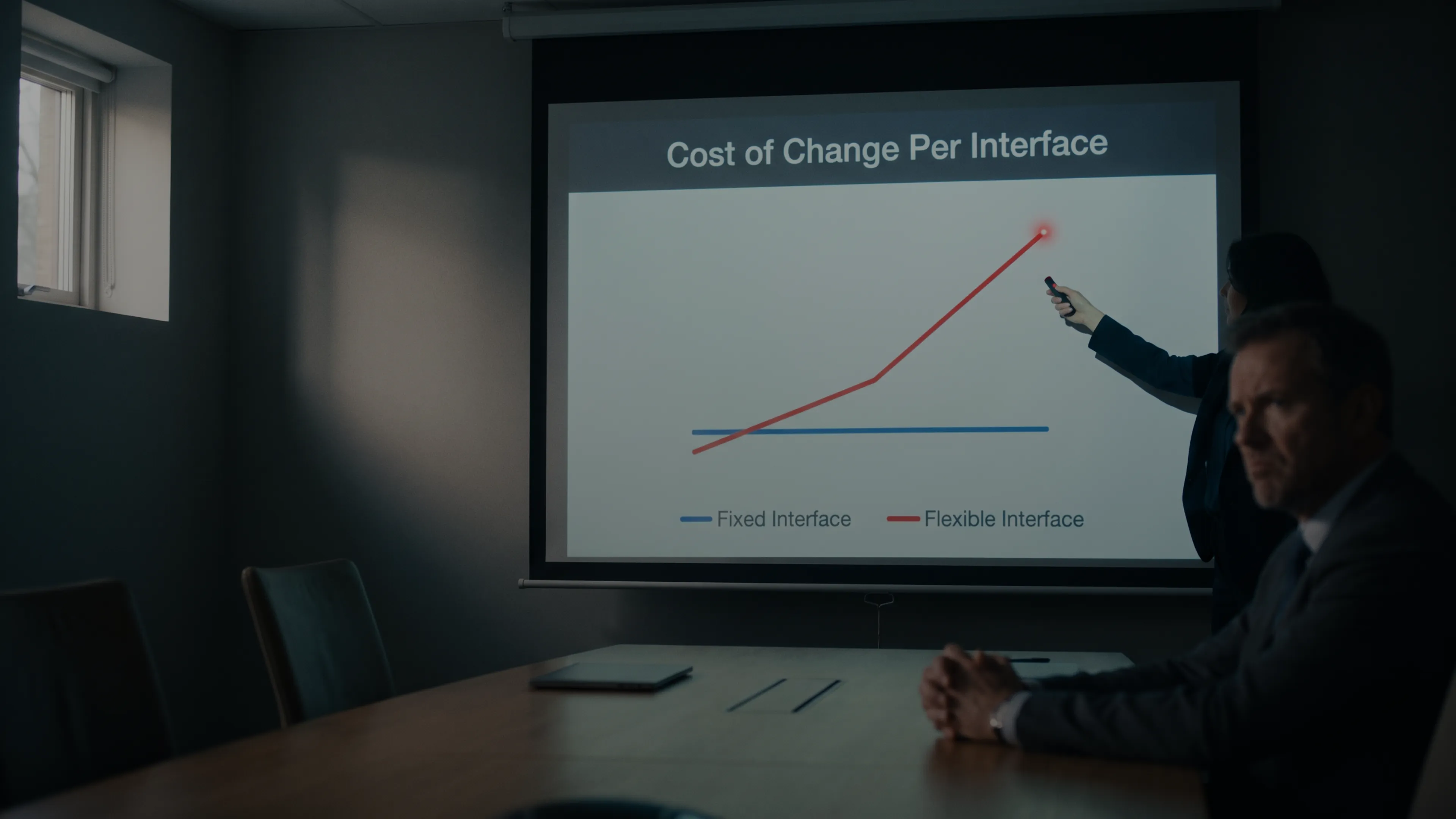
  • The Pursuit of Flexible Interfaces Is Modularity's Silent Killer

    Every module in your product has a single human owner who treats it as their own, and that ownership standard gives you the authority to say no to unnecessary change. The next article reveals why the most well-intentioned engineering teams undermine that authority every day: by pursuing flexible interfaces that dissolve the very boundaries ownership protects. You'll see how discovery-based interfaces become modularity's silent killer, why "smart modules" that perform operations stay stable while dumb modules invite constant renegotiation, and what a three-gate governance chain from product management to the CTO looks like. The CEOs who understand this before their engineering teams demand interface flexibility will preserve the modular architecture their competitors quietly lose.

    October 6, 2026 · Article 16

  • Your Sprint Report Tells the Truth but Hides Everything That Matters

    The CEO has your Sync Tax multiplier on the slide, nods, and asks when the next feature ships. Data alone gets a nod and a 'next' slide. The next article gives you the trade-off language to turn that metric into a shared decision, so the $40,000 Sync Tax on a feature becomes a visible fork both leaders negotiate together. A CTO who cannot say no costs more than any one bad feature ever could, and this framework gives them the language to say it.

    August 25, 2026 · Article 10

  • The Setup That Turns a 20-Hour Feature Into an 80-Hour One

    Your engineering team just shipped a feature that took 80 hours, but the real work was only 20 and the rest was tax. The next article introduces the Sync Tax Multiplier, a single number that reveals why that happens and shows how to measure the hidden dependencies and coordination overhead that drain your roadmap. This is the metric that makes the invisible visible, and the first CEO who quantifies it outruns competitors who never look.

    August 18, 2026 · Article 9

  • Decisions That Look Good Today and Hurt the Company Tomorrow

    A feature greenlit to close a deal can look like revenue today and still compress the margin long after the ink is dry. The next article closes that strategy-to-engineering gap without turning the CEO into an engineer. It covers the culture that lets experts speak without fear, the repayment contract on every quick-and-dirty path, and the estimation gap that exposes yes-men when culture alone won't. When the CEO is the single point of failure for whether truth reaches the decision, tomorrow's options hang on those conditions.

    August 4, 2026 · Article 7

  • Treat Every Module Like an Outside Company

    The next article treats every module like an outside company, not a department you can rifle through when a deadline is tight. It lays out the Autonomous Cooperation Protocol: self-contained requests, hard ownership at the interface, and the economic case for refusing the "just in case" field that looks free today and keeps costing you later. It also names the speed trap that starts in the C-suite and ends with engineers taking shortcuts, then shows why throwing more headcount at a tangled system is the mark of a manager who misread the bottleneck. If you've ever watched a clean boundary die so one ticket could ship this sprint, this is the discipline that would have stopped it.

    July 28, 2026 · Article 6

  • The Hardest Part of Scaling a Software Company Isn't Technical

    The cheapest way to destroy a software company is to let Business, Product, and Tech speak different languages until nobody can tell a real constraint from a political maneuver. The next article replaces that ambiguity with a hard protocol, one that forces every department to translate its needs into location and cost, the only terms a CEO can act on. It explains why story points survive despite generating distrust every time they appear on a roadmap. And it introduces the dignity threshold, the boundary that separates an expert advisor from a yes-man paid to nod at bad decisions.

    July 14, 2026 · Article 4

  • You Don't Automate the Levers of the Past

    Automating a broken process does not fix it. It just makes the broken process faster, and most of the spending labeled "automation" in the last decade was really a subsidy paid to preserve the inefficiency underneath. The next article argues that efficiency has to come first, not as a slogan, but as a precondition, because the candlemaker lost his job the day electric light arrived, not the day someone optimized his wick. We pull the Paradox of Automation apart to show why the more efficient the system gets, the more valuable the human inside it becomes, and the more expensive it becomes to keep scaling with sync tax still lodged in the codebase. If you have ever seen a team "automate" their way into a bigger mess, this is the argument you wish they had read first.

    July 7, 2026 · Article 3

  • The Architecture Of Independence

    A modular interface isn't a technical artifact. It's the treaty that lets two teams operate as separate companies, shipping in parallel. The Rule of the Bolt keeps them intact with immutable identifiers, and shows why engineering shortcuts become a permanent tax.

    June 30, 2026 · Article 2

  • The Sync Tax

    Capital before demand doesn't fund a business, it subsidizes the illusion of one. This piece traces how premature funding detaches companies from their market, how the unrecognized cost of keeping systems in sync multiplies with every feature shipped, and why the moment after product-market fit demands subtraction rather than addition.

    June 23, 2026 · Article 1