The Engineering Tax · Article 22 of 29
The Architecture That Found Product-Market Fit Becomes Why You Can't Scale
You hit product-market fit. The architecture that got you there just started billing you, and the invoice lands on your roadmap, your margin, your seat. The next article breaks down when integration flips from an asset into a liability, the decoupling point that tells you when to switch strategies, and the actual cost of mistiming that switch by even one quarter. You'll walk away with the framework to see this cost before it compounds, a head start that decays with every quarter you wait.

When Integration Becomes a Liability
1. The PMF Coincidence
In practice, product-market fit and the first decoupling point happen at roughly the same time. I call it a coincidence because they aren’t the same thing, but they land more or less together. At its core, product-market fit means the market validated the job you’re trying to do. Real product-market fit shows up when people buy it, use it, and would be upset if it disappeared. The decoupling point, on the other hand, means your architecture can no longer sustain the demand that product-market fit creates.
In my experience, the leaders I worked with had never heard of a decoupling point. Instead, they celebrated product-market fit as pure revenue-making victory and missed that their architecture was turning into a liability. Rather than pausing to reassess, they kept building features in the same messy integrated system that got them there, thinking success meant more of the same. In reality, success means the rules changed, and the companies that survive are the ones that learn the new rules.
Once product-market fit hits, demand grows faster. Suddenly the product needs to do four things it didn’t have to do before: support more simultaneous users, support more flexibility, and make product changes faster to stay competitive. It also needs to lower the cost of serving each customer so the business can actually scale.
2. What “Good Enough” Means
Here’s the theory in its simplest form: when a product isn’t good enough yet, customers pay for better performance no matter how you achieve it. Consider early smartphones: they were terrible at everything. That’s why Apple controlled the entire stack and tuned every component. In that market, integration made sense because the market valued product performance above all else.
“Good enough” means the customer no longer cares about marginal performance gains. For example, the phone makes calls, runs apps, and the battery lasts a day. At that point, another 10% battery life doesn’t matter. Then the market shifts. Instead, customers want lower cost, faster delivery, and more choice. By contrast, integration locks you into slow, expensive changes.
In software, this maps cleanly. Before product-market fit, you’re in discovery mode: tuning the product, learning what customers actually want. With interdependent components, you can iterate fast because anything can change without worrying about interfaces. After product-market fit, the game changes. At that point, you’ve defined a product that aligns with the job your customers need done. But every feature you add to an integrated system creates more interdependence, increasing complexity and the cost of change. Ironically, the architecture that helped you find product-market fit becomes the reason you can’t scale it.
3. Cycling Between Discovery and Efficiency
The distinction between emergent and deliberate strategy, from Professor Christensen’s work, is what makes this framework practical. Emergent strategy comes from discovery: you try things, learn from the market, and adapt. Deliberate strategy flips the focus to efficiency once you know what works.
Picture the product lifecycle as a permanent cycle. During the emergent phase, you chase performance until the product aligns with the job to be done. Then deliberate strategy takes over, modularizing to protect that alignment, lower cost, and make modifications faster and cheaper. When the market evolves or a competitor disrupts you, alignment degrades and you switch back to emergent to find the new alignment. Then deliberate again, and the cycle continues.
Since this isn’t something business leaders discuss openly, they miss the right time to switch strategies. Some leaders stay in emergent too long, never modularizing and adding features without making their product efficient first. Or they can switch too soon, making the discovery process too constrained and expensive. Still, the main problem is always cost affecting profitability. If a product isn’t profitable, pouring more money into it isn’t wise. Especially to scale, the product must be profitable first. Otherwise you’re just accelerating a money-losing machine.
4. What Wrong Timing Costs You
Too Late
Getting the timing wrong goes in two directions, and both are expensive. When a company hits product-market fit and stays emergent, the cost compounds in three ways.
First, feature development slows down. In an integrated system, every new feature touches multiple components across the stack. A change in the billing logic breaks the reporting dashboard while a change in the user profile breaks the recommendation engine. Engineers spend more time untangling interdependence than building anything new, and the team’s velocity grinds to a crawl.
Second, the cost per customer rises when an integrated system hits its scaling ceiling. A monolith built for a thousand users can’t handle ten thousand without the database timing out on complex queries. At a hundred thousand, every request triggers cascading lookups across shared tables, locking rows and degrading performance for everyone. The engineering team pivots from building features to firefighting, while each caching layer, database replica, and performance patch adds maintenance burden that compounds with every new signup.
Third, the company loses the alignment that made it successful. In emergent mode, features drift from the core job instead of serving it. The product bloats, its value proposition gets diluted, and customers start looking elsewhere.
At one company I worked for, the product page took two minutes to load because the monolith executed dozens of SQL queries in a single request. Business and tech leadership were both against breaking it up, although fixing the queries problem wouldn’t need a migration to microservices, it was just terrible code. According to them, microservices add network overhead and complexity. Looking back, I know they rejected it because they didn’t understand the difference between microservices and modularization. They chose to keep a bloated integrated system because they didn’t understand the cost of their decisions.
Too Early
Modularizing before product-market fit is equally dangerous. When you don’t know the job to be done, you can’t define stable interfaces. But you modularize around guesses, and every guess becomes expensive to undo.
Remember: integration wins when performance requirements are still evolving. After all, early modularization creates rigid boundaries around fluid requirements. From there, you end up with modules that don’t match the actual job, and the cost of redefining interfaces is higher than the cost of iterating in a monolith.
Research confirms this. Specifically, startups that adopt microservices before product-market fit take up to 45% longer to ship their first viable product, either because of too-early modularization or because they don’t implement microservices properly. In practice, the operational complexity of distributed systems consumes engineering bandwidth that should go into finding the job the customer is demanding. And debugging gets harder, transactions get harder, and coordination gets harder. At scale, all of this makes sense. But it’s catastrophic when you still don’t know what you’re building.

5. How to Measure “Good Enough”
You know the product is “good enough” when established metrics prove it. Before examining the numbers, understand what you’re measuring. Product-market fit has two distinct components, and you need both before deciding to modularize.
First up is demand validation. Customers who want the product buy it, use it, and would be upset if it disappeared. That tells you the job is real and the product is doing it.
Retention validation is the second component. Over time, users keep coming back, not just trying it once. Consistent usage, not initial curiosity, confirms the job is being done consistently.
Put them together and you get the first formula:
You need both components. On its own, demand without retention gives you hype, not a business. Without demand, even strong retention means you have a niche, not a market.
Now, product-market fit alone doesn’t tell you to modularize. You also need cost pressure: the variable cost per customer is rising, feature development is slowing down, and engineering effort per change is growing. When you have product-market fit and cost pressure at the same time, you’ve reached the decoupling point:
The decoupling point is the moment your architecture must change from integrated to modular. At that point, the cost of staying integrated grows faster than your revenue, so holding onto the old architecture means losing money with every new customer.
Here are the specific metrics that measure each component.
Demand validation: A simple user survey asks, “How would you feel if you could no longer use this product?” If 40% or more say “very disappointed”, you have strong product-market fit on the demand side. This measures emotional dependency. In turn, it tells you the job is real and the product is doing it.
Retention validation: Retention curves show whether users stay after the initial drop. A healthy curve flattens at a non-zero percentage. If it hits zero, the product has no staying power. If it flattens at 30%, that means 30% of users find enough value to stay long-term. All of this confirms the product is doing the job consistently.
Cohort analysis compares successive groups of users. If your January cohort has 25% retention at 90 days, and your June cohort has 38%, the product is getting better at serving the job. This trajectory proves the alignment is improving.
Net Revenue Retention above 110% for B2B products means existing customers expand faster than they churn. Financially, this signals that customers built the product into their workflow.
Early Warning Signals
The same metrics that confirm product-market fit also tell you when alignment is degrading, months before churn spikes. Watch for: time to first value increasing, NPS declining, retention curves failing to flatten, feature usage concentration shifting (the features that used to drive retention no longer do), DAU/MAU ratio declining, and session frequency declining. All of these are leading indicators that the job to be done is drifting away from what your product offers. When you see them, the cycle is telling you to switch back to emergent.
6. Modularization Is Not Microservices
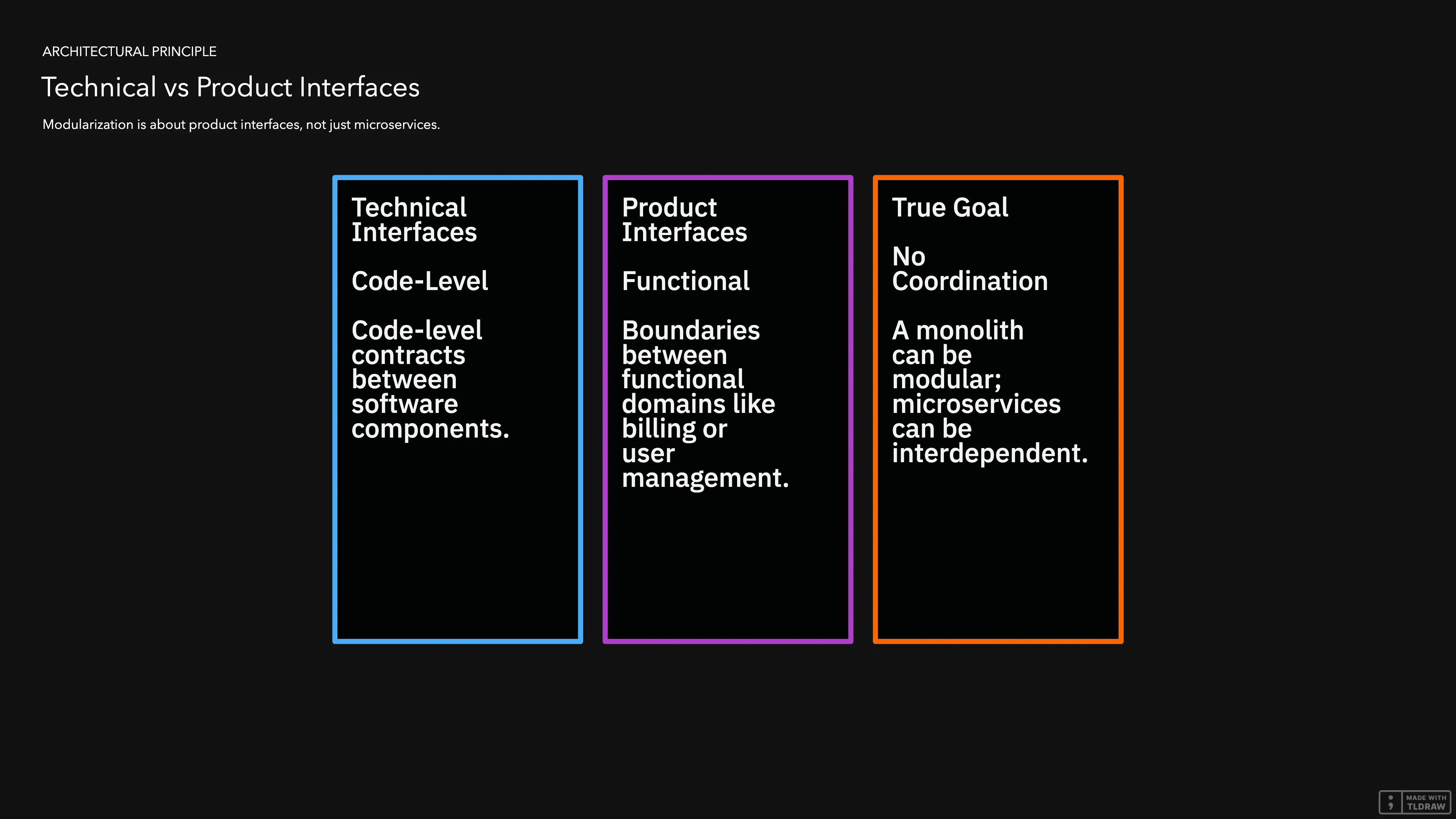
This is the mistake I saw most often. When tech teams hear “modularize,” they think “microservices.” The monolith gets broken into smaller services without defining product interfaces. The result is distributed interdependence, which is worse than a monolith.
There’s a distinction that gets lost here. On one side, technical interfaces are code-level contracts between software components. On the other, product interfaces are the boundaries between functional domains, like billing, user management, or reporting, that let teams work independently without coordinating every change. This article is about the second kind. Of course, technical interfaces exist, but the theory is about boundaries at the product and business level, not the code level.
At another job, the company spent years extracting features from the monolith into microservices. Module boundaries were never defined first. No one created stable interfaces in a way that a team maintaining a module doesn’t have to coordinate with other teams every time they make a change to their own domain. Features were extracted while making modifications, so every possible cost compounded. When the monolith was finally killed, the company had a distributed system where every service depended on every other service. The sync tax, the hidden coordination cost that interdependent architectures force on teams, far from disappearing, got way worse because now …
As soon as the monolith was gone, another huge refactor started. It soon became a never-ending refactor. The team had traded one kind of complexity for a more expensive kind.
Microservices are an implementation choice. Modularity is a vital architectural principle. A monolith can be modular if it has clean internal boundaries. In contrast, a microservice architecture can be interdependent if services share databases or require constant synchronization. Ultimately, what matters is whether your components can evolve independently without disrupting the rest, maintained by different teams without the need for constant coordination.
7. Market Forces Don’t Wait for You
At this stage, no one gets to decide whether the market shifts. When products become “more than good enough,” the market changes with or without you. Competitors who modularize first deliver lower cost, faster iteration, and more flexibility. Meanwhile, customers who no longer value marginal performance walk away.
And this is why timing matters. If you modularize too early, you lock in the wrong boundaries and lose the ability to iterate, increasing the cost of change. If you modularize too late, your cost structure is already broken and competitors have captured the advantage.
According to independent research from HBS, the optimal time to switch to modular upgradability is when performance improvements approach saturation. At that point, customers perceive incremental advances as marginal. Eventually, speed and cost become the competitive weapons.
This shift depends on standardization. USB standardized the interface, which allowed the PC industry to modularize. The same pattern is happening now in AI, where new standards are starting to define clean interfaces between components. In turn, standards convert unpredictable interdependencies into clean, reliable interfaces. Once standards emerge, modular competitors enter with specialized, lower-cost components.
8. Why Companies Fail
In my experience, companies fail for three reasons, and behind all three sits the same root cause: politics and ego. None of the people I worked with understood the business, technical, and economic dimensions of a software product simultaneously. The CEO optimized for revenue without connecting strategy to architecture, while the CTO optimized for engineering purity without connecting code to business outcomes. Politics and ego made sure every decision got made in isolation, and the product suffered for it.
First, they don’t know the framework. The CEO had never read Christensen, and his CTO never connected architecture to economics.
Second, they don’t understand the cost of wrong timing. One VP of Engineering rushed to microservices because it was trendy, spending millions on distributed infrastructure before defining stable interfaces. The head of Platform resisted any change because he feared the unknown, blocking every attempt to simplify. Neither leader could articulate what the wrong decision cost in dollars and time, and neither had a framework for choosing between trend and caution.
Third, tech and business don’t speak the same language. The product team wants more features and more revenue while engineering wants clean architecture. Neither side can translate its priority into the other’s terms, so the result is constant conflict or unsatisfying compromise.
For a while, bad decisions were subsidized by investor money or lucky market demand. Investors chose to fund unprofitable scaling, betting that growth would eventually produce profitability, or even colluding with company leaders in some cases to inflate their valuation to secure a profitable exit for themselves at the business expense. However, investors are getting more selective, money is becoming less easy to raise, and the companies that never learned the framework might not survive for long.

9. Putting the Framework to Work
Fundamentally, emergent strategy means starting with an integrated product and iterating fast. In practice, product-market fit gets measured with the 40% disappointment survey, retention curves, and cohort analysis. Modularization only makes sense when the evidence is clear that the product is good enough.
When product-market fit is proven, deliberate strategy takes over. Critically, the job to be done is defined precisely, along with the components that serve it. These stable interfaces between components let teams measure the coordination cost between them. In turn, this lowers the variable cost per customer and protects the alignment that made the product successful.
When the market evolves and alignment degrades, the cycle switches back to emergent. Re-align the job to be done, iterate until you hit product-market fit again, then deliberate again.
But the cycle never ends because product-market fit keeps moving. In the end, the companies that survive learn when to integrate, when to modularize, and how to tell the difference.
References
- Clayton Christensen Institute, Modularity Theory - Framework explaining how product architectures shift from integrated to modular as performance becomes “good enough.”
- Harvard Business School Online, Emergent vs. Deliberate Strategy - Christensen’s distinction between strategy formation processes in uncertain vs. clear conditions.
- Appinventiv, Microservices vs Monolithic Architecture for Startups - Analysis of how premature microservices adoption slows startup velocity.
- Sean Ellis, Using Product-Market Fit to Drive Sustainable Growth, GrowthHackers (2017) - Original methodology for the 40% “very disappointed” PMF survey.
- SaaS Capital, 2023 B2B SaaS Retention Benchmarks - Industry benchmarks showing NRR above 110% as top-quartile for B2B SaaS.
- Harvard Business School Online, Business Modularity - Christensen on how USB standardization enabled the PC industry’s shift to modularity.
- Clayton Christensen, The Innovator’s Dilemma (1997), HBS Faculty Page - Foundational work on performance oversupply, disruption, and the conditions that trigger modularization.
Measure it
Price the architecture that found product-market fit
Product-market fit and the first decoupling point land together, and the integrated system that won the market starts billing the roadmap. The calculator shows the Sync Tax on the next feature while that architecture is still treated as an asset.
Up next in The Engineering Tax · Article 23
The Cost of the Shortcut Compounds Non-Linearly, and Nobody Sees It
You approved the fast-path feature again this quarter, and the cost felt invisible. The next article installs a simulation that projects exactly where those invisible installments land: on your margin, your roadmap, your seat. It compares the disciplined path against the shortcut, running the numbers through 6, 12, and 24 months, and what emerges is a cost multiplier that compounds non-linearly with every additional fast-path feature. The first leader who runs this simulation before the next feature decision sees the gap others won't notice until it's too late.
Coming soon
Frequently asked questions
When to Modularize: The Christensen Timing Framework
What is the Christensen Timing Framework?
Clayton Christensen showed that when a product becomes good enough, the basis of competition shifts from performance to flexibility. Before PMF, integration lets you iterate fast. After PMF, integration becomes a liability. Every feature you add to an interdependent system increases complexity and slows you down.
Why do most leaders miss the timing?
PMF and the decoupling point happen at the same time, but leaders celebrate PMF as a revenue victory and miss that the architecture is becoming a liability. Success doesn't mean more of the same. The rules changed. The companies that survive learn the new rules. The ones that don't keep building features in the same messy system that got them there.
How to Tell a Product Is Good Enough to Modularize
How do you know a product is good enough to modularize?
Product-market fit needs both demand validation and retention validation. Demand means people buy it, use it, and would be upset if it disappeared. The article cites the survey threshold: 40% or more saying they would be very disappointed. Retention means users keep coming back, shown by a curve that flattens above zero, by cohorts that retain better over time, and, for B2B, net revenue retention above 110%. Product-market fit alone does not say modularize. You also need cost pressure: rising variable cost per customer, slower feature development, and growing engineering effort per change. Product-market fit plus cost pressure is the decoupling point.
What does modularizing at the wrong time cost?
Too late, and every feature touches multiple components, cost per customer rises as the integrated system hits its scaling ceiling, and features drift off the job that made the product succeed. Too early, and you modularize around guesses. The article cites research that startups adopting microservices before product-market fit take up to 45% longer to ship a first viable product. Integration still wins while performance requirements are evolving. Stable interfaces need a job you already understand.
Why Monoliths Are Not the Enemy
Why Monoliths Are Not the Enemy
Before the Decoupling Point, a monolith helps you move fast. You change anything without worrying about interfaces because you're still discovering what customers want. Integration during this phase is a competitive advantage. After the Decoupling Point, the same integration becomes a liability. Customers stop paying for raw performance and start demanding flexibility. The problem isn't that you have one deployment.
What else should leaders know about Why Monoliths Are Not the Enemy?
It's that everything depends on everything else. You can have a monolith that's well-modularized internally, or microservices that are tightly coupled. Deployment topology matters less than dependency structure. Don't break up your monolith because microservices are trendy. Break it up because your Connascence Degree is rising and your velocity is dropping. If neither is true, your monolith is probably fine.
Newsletter
Be the first to get next articles in this series.