Skip to content

Tag

interfaces

11 articles

  • The Architecture That Found Product-Market Fit Becomes Why You Can't Scale

    You hit product-market fit. The architecture that got you there just started costing you more with every release, and that cost falls on your roadmap, your margin, your seat. The next article breaks down when integration flips from an asset into a liability, the decoupling point that tells you when to switch strategies, and the actual cost of mistiming that switch by even one quarter. You'll walk away with the framework to see this cost before it compounds, a head start that decays with every quarter you wait.

    November 17, 2026 · Article 22

  • You Can't Steer When You Only See the Destination

    You see the Sync Tax Multiplier as a single number, but the curve it follows over time is where the real story lives. A line that bends upward month after month, quietly compounding cost while your attention stays on the endpoint. The next article maps those curves (the divergence, the J-curve and the hidden cost) so you see the crossover before your money is committed.

    November 10, 2026 · Article 21

  • Coupling Isn't a Binary Switch, and Every Level Has a Price

    You are making interface decisions that will cost you on every feature you build after them. The next article connects each dimension of interface design (visibility, domain scope, direction, synchronicity, contract formality, communication and coordination) to a connascence level that feeds directly into the Sync Tax and extraction cost formulas from this one. The first leadership team that sees the price of their choices before making them will cut waste competitors never detect.

    November 3, 2026 · Article 20

  • Every Change to Your System Risks Breaking Something That Was Working

    You approved a feature that came in nearly double the estimate because the cost of what it broke never showed up in the budget. The next article builds a single multiplier from your regression rate and incident cost, using the same logic insurers use to price risk, converting any build estimate into the true cost including everything your change breaks. One number that turns a guess into an economic decision. The first CEO who applies it cuts waste competitors can't even see.

    October 20, 2026 · Article 18

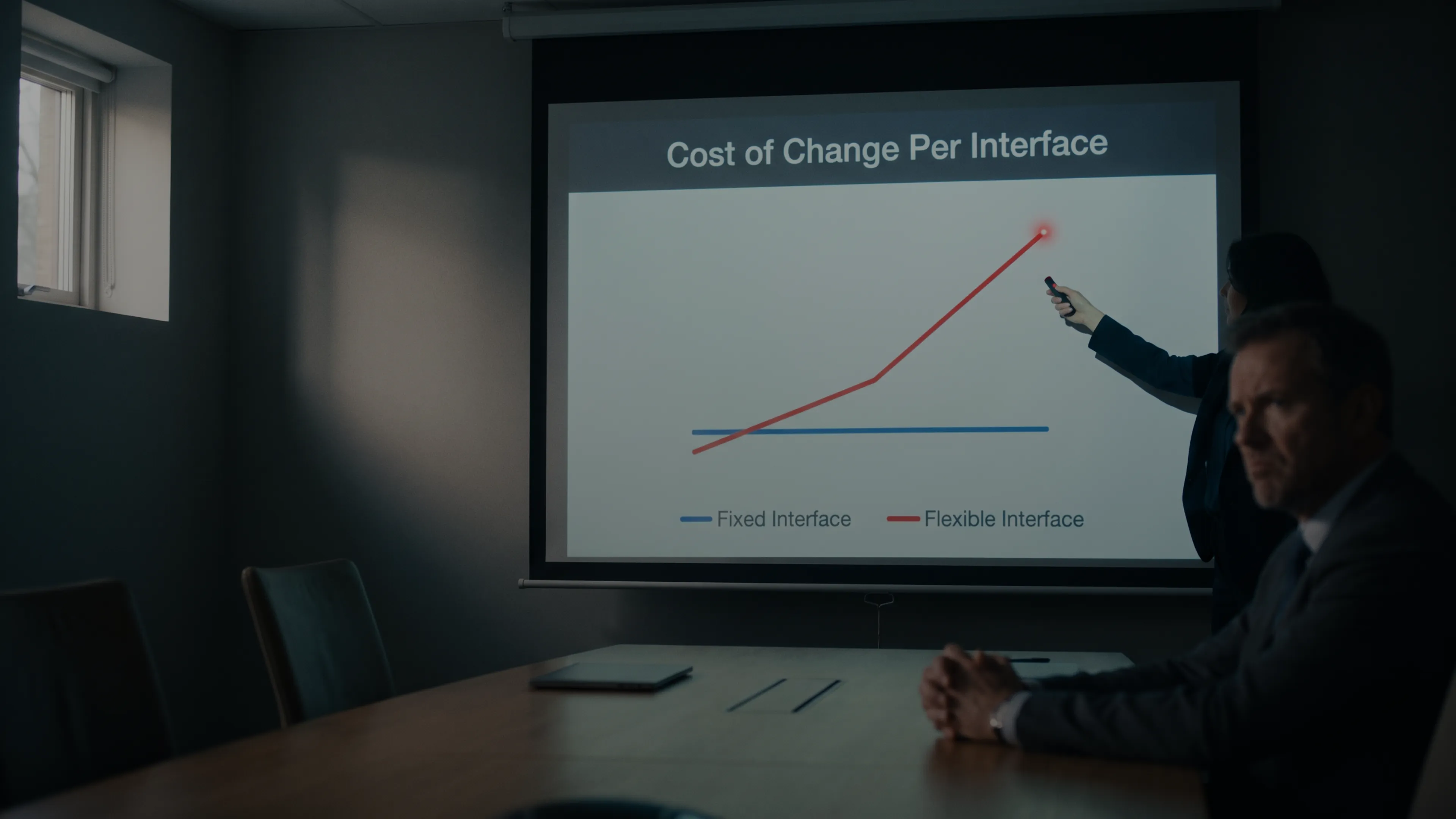
  • The Pursuit of Flexible Interfaces Is Modularity's Silent Killer

    Every module in your product has a single human owner who treats it as their own, and that ownership standard gives you the authority to say no to unnecessary change. The next article reveals why the most well-intentioned engineering teams undermine that authority every day: by pursuing flexible interfaces that dissolve the very boundaries ownership protects. You'll see how discovery-based interfaces become modularity's silent killer, why "smart modules" that perform operations stay stable while dumb modules invite constant renegotiation, and what a three-gate governance chain from product management to the CTO looks like. The CEOs who understand this before their engineering teams demand interface flexibility will preserve the modular architecture their competitors quietly lose.

    October 6, 2026 · Article 16

  • Every Piece of the Product Needs a Single Human Owner

    You just finished drawing the boundaries on the whiteboard. Each component now needs a single human who answers for its future, or orphan code will derail your roadmap with surprise projects and burned-out engineers. The next article shows why assigning ownership early locks in the architecture you built, while competitors who skip this step pay later in degraded components and lost velocity.

    September 29, 2026 · Article 15

  • There Are No Natural Boundaries Waiting Inside Your Monolith

    Your monolith has no natural boundaries waiting inside it. Every component is a product with its own margin, and the wrong cut costs more than leaving the whole thing intact. The next article shows how to read the economic signals that reveal where the real seams are, starting with the product, before the sync tax swallows your roadmap.

    September 22, 2026 · Article 14

  • The Way Teams Talk Shapes the Software They Build

    You walk past a meeting room where two teams are hashing out a small change. That coordination meeting isn't a scheduling problem; it is a structural signal that the architecture has no defined boundary between components. The next article reveals how the CTO can read that signal and redesign the communication structure, using modular interfaces that turn each team into a sovereign unit. The discipline that follows lets you see the margin drain before your next roadmap meeting.

    September 8, 2026 · Article 12

  • Treat Every Module Like an Outside Company

    The next article treats every module like an outside company, not a department you can rifle through when a deadline is tight. It lays out the Autonomous Cooperation Protocol: self-contained requests, hard ownership at the interface, and the economic case for refusing the "just in case" field that looks free today and keeps costing you later. It also names the speed trap that starts in the C-suite and ends with engineers taking shortcuts, then shows why throwing more headcount at a tangled system is the mark of a manager who misread the bottleneck. If you've ever watched a clean boundary die so one ticket could ship this sprint, this is the discipline that would have stopped it.

    July 28, 2026 · Article 6

  • The Hardest Part of Scaling a Software Company Isn't Technical

    The cheapest way to destroy a software company is to let Business, Product, and Tech speak different languages until nobody can tell a real constraint from a political maneuver. The next article replaces that ambiguity with a hard protocol, one that forces every department to translate its needs into location and cost, the only terms a CEO can act on. It explains why story points survive despite generating distrust every time they appear on a roadmap. And it introduces the dignity threshold, the boundary that separates an expert advisor from a yes-man paid to nod at bad decisions.

    July 14, 2026 · Article 4

  • The Architecture Of Independence

    A modular interface isn't a technical artifact. It's the treaty that lets two teams operate as separate companies, shipping in parallel. The Rule of the Bolt keeps them intact with immutable identifiers, and shows why engineering shortcuts become a permanent tax.

    June 30, 2026 · Article 2