The Engineering Tax · Article 15 of 29
Every Piece of the Product Needs a Single Human Owner
You just finished drawing the boundaries on the whiteboard. Each component now needs a single human who answers for its future, or orphan code will derail your roadmap with surprise projects and burned-out engineers. The next article shows why assigning ownership early locks in the architecture you built, while competitors who skip this step pay later in degraded components and lost velocity.
Accountability, Leadership, and the People Behind Modular Architecture
A product built from independent pieces is only as strong as the humans responsible for each piece. The companies that scale cleanly make sure every piece of the product has a single human who treats it as their own. Without that, the system rots from the inside, and the company pays the bill in missed deadlines, surprise projects, and complexity that nobody can answer for.
1. Ownership Is a Human Commitment
Modular architecture (splitting the product into independent pieces that talk to each other through contracts) lives or dies by its interfaces, but interfaces mean nothing without humans who stand behind them. Ownership is a human commitment that no spreadsheet cell or repository annotation can capture. The owner is the person who answers when something breaks in their area of responsibility and who evaluates new requirements. They understand the component (a piece of the product, also called a module) deeply enough to say no when a request would damage the system.
This person must be a leader: someone who takes responsibility and marshals the team’s expertise. The team holds the expertise, but the owner marshals that expertise and carries the accountability. If the person with the deepest domain knowledge is a terrible leader, the answer is obvious: they should report to a good leader who can deploy their domain knowledge at full force. Leadership and ownership are the same job. A good owner leads, and a good leader owns the outcome. The owner who delegates ownership instead of tasks has already failed. Delegating tasks is healthy; delegating accountability is cowardice.
The owner says no to requirements that lack economic justification. The owner who says yes to everything to keep people happy in the short term has abandoned their duty. They avoid the hard conversation today and guarantee a harder conversation tomorrow when the component collapses under undocumented compromise. Research backs this connection. When ownership is clear, people take responsibility for defects and quality1. When it’s vague, accountability evaporates.
2. The Real Cost of Orphan Code
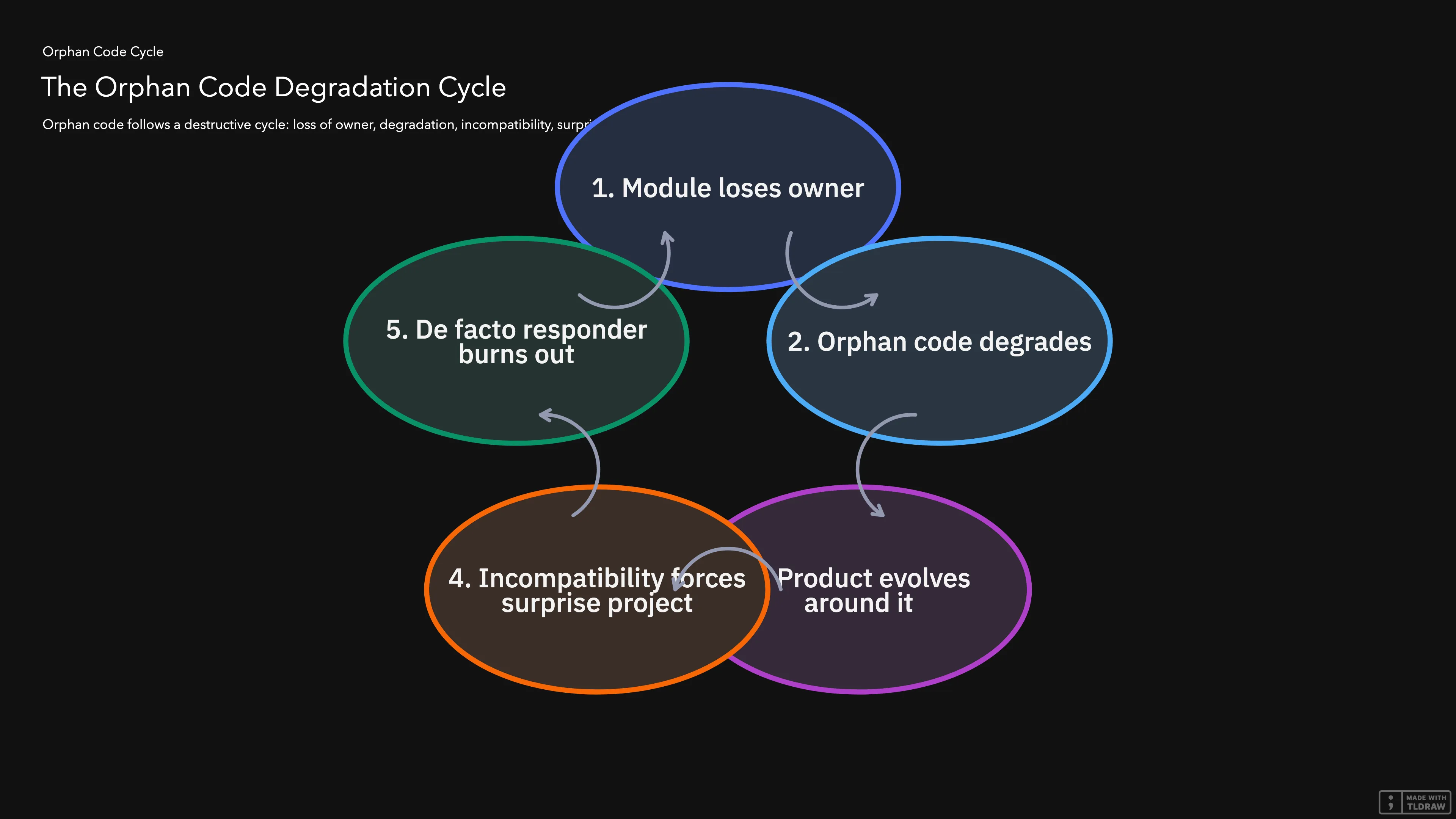
When a module loses its owner, it degrades. The product evolves around it, and the orphan component grows incompatible with the rest of the system. Eventually another component that depends on it needs a change, and the company discovers a surprise project.
A senior engineer who had been around long enough to remember how the module worked became the de facto responder, buying the company time. But he was not the owner, and nobody had given him the task to evolve the module forward. The company limped along until that engineer left or burned out, and then the orphan became an emergency again. When the emergency hits, someone must step up. That person must find a human willing to take responsibility, learn the area from scratch, and execute the work.
This kind of rescue blocks execution and destroys deadlines, and the cost is easy to estimate. Take the average hourly compensation of everyone pulled into the rescue, multiply by the number of people, multiply by the hours or days consumed. The number is never small. It includes engineers, managers, and the opportunity cost of whatever those people had committed to build instead but didn’t.
The research numbers confirm the damage. Technical debt from unowned components drains a meaningful share of every engineering budget, and orphan code is a major contributor2. Open-source projects that lose all their key engineers fold, and files abandoned by their original developers stay abandoned for years, creating knowledge gaps that compound over time3.
Ownership fails gradually, and the first signal is automatic agreement. When the owner says yes to every requirement without analyzing consequences, they have stopped owning the area. They treat their component as a service desk rather than a sovereign product with economic boundaries.
The second signal is the delegation of ownership itself. Delegating tasks isn’t the same as delegating accountability. The owner can hand off the work, but they can’t hand off the responsibility. When an owner starts treating their responsibility as someone else’s problem, nobody owns the component in practice even if a name remains on the org chart.
A third signal appears in meetings. If other teams must coordinate extensively with the owner to get basic questions answered, the owner has failed to make the team self-sufficient. A leader’s goal is to make the team self-sufficient, so it operates without them. A well-led team continues operating when the leader is absent because the team distributes knowledge and authority properly. The owner’s job is to distribute knowledge and authority so the team runs without them.
4. Interface Contracts Belong to the Owner
The owner controls the interface contract, the agreement two independent pieces of the product make about how they’ll exchange data. The owner signs off when the team creates the interface and defends its stability forever afterward.
Interfaces should almost never change. Think of them as contracts because they function like legal agreements between independent entities. A product is stable when its internal interfaces are stable. If an external module attempts to use an interface in an incompatible way, that is the other module’s problem to solve, and the contract stays put.
Research confirms this discipline. The way the pieces connect must stay predictable from the moment the team publishes them. Breaking changes impose asymmetric costs. The change itself is quick, but affected teams may spend days diagnosing and fixing integrations. Enterprise buyers specifically evaluate how stable a vendor’s connections are before signing large contracts4. Stability is a discipline you enforce from day one.
5. The Owner’s Duty of Replacement
An owner who plans to leave has one final responsibility. They must find and train their replacement. This duty falls on the departing owner. The departing leader knows the area, knows the team, and knows what the role requires.
Everyone on the team collaborates to bring the new leader up to speed, but the outgoing owner drives the transition. If the owner leaves without a replacement, the company pays the cost of an unmanaged handoff immediately.
Reality rarely cooperates. Sometimes the departure is hostile and the company removes the owner for cause, without giving them a chance to hand off. That transition is dangerous and likely to fail. The company chose speed over knowledge transfer. Sometimes the domain owner is the problem and the firing is correct, but the company still pays the price of an unmanaged handoff. The best protection is proactive knowledge transfer that happens long before anyone quits or the company lets them go.
This is why embedding cross-training and documentation into daily workflows matters more than last-minute handoffs. The best time to transfer knowledge is before you need it urgently. Teams that build it into their routine absorb departures as non-events. Research shows that documentation alone is insufficient5. True understanding comes from working with systems, making changes, and solving problems. Five categories of knowledge require different transfer methods: how the system fits together, why the team made past decisions, how to operate it day to day, unwritten habits the team relies on, and the actual subject matter. Each demands a specific approach, from recorded walkthroughs to pair programming.
6. Documentation as Ownership Infrastructure
Ownership requires infrastructure, and documentation is part of it. But documentation must meet three standards or it’s worse than useless.
First, the documentation must mirror the system it describes. Outdated documentation creates false confidence.
Second, the system must generate and update it automatically. Manual documentation is too expensive to keep current, and humans will abandon it under pressure.
Third, newcomers must read it as part of onboarding. Unread documentation is digital litter.
Even with perfect documentation, the owner remains essential. Documents can describe systems, but only a human owner makes decisions, evaluates trade-offs, and rejects requirements that lack economic justification.
7. Who Assigns Ownership
In a company with a tech department and a CTO, the CTO holds ultimate authority over ownership assignments. Middle managers handle day-to-day decisions for their teams. But restructuring that shifts team boundaries or module sovereignty requires CTO involvement. This authority exists because ownership is a capital allocation decision that determines who controls the resources tied to each module.
The CTO must understand the interfaces, the teams, and the economic justification for every module’s existence. When a module has no owner, the CTO assigns one. When an owner fails, the CTO replaces them.
This is about module-level sovereignty: the component, its interface, its data, and its economic contribution must have a named human who answers for all of it.
8. The Economic Imperative
Everything in this article reduces to a single economic principle. A component that serves demand efficiently justifies its existence. A component without an owner can’t serve demand efficiently because no one is accountable for its margin, its interface stability, or its evolution.
Ownership is how you prevent the sync tax of orphan code. It’s how you enforce interface discipline without bureaucratic committees. It’s how you ensure that every module has a human who treats it as a sovereign product with its own economics.
The companies that master this don’t scale by adding coordination. They scale by making every component independently accountable. That’s the ownership standard.
References
Footnotes
-
Greiler, M., Herzig, K., & Czerwonka, J. (2015). “Code Ownership and Software Quality: A Replication Study.” IEEE/ACM 12th Working Conference on Mining Software Repositories (MSR 2015). Link ↩
-
Protiviti. (2025). “Global Technology Executive Survey: Tech Debt a Major Burden.” Link ↩
-
Avelino, G., et al. (2019). “Beyond the Truck Factor: On the Survival of Open Source Projects.” IEEE/ACM 16th International Conference on Mining Software Repositories (MSR 2019). Link ↩
-
TechnologyMatch. “What Are the 5 Key Supplier Evaluation Criteria?” Link ↩
-
Kroll, J., Mäkiö, J., & Assaad, A. (2016). “Challenges and Practices for Effective Knowledge Transfer in Globally Distributed Teams: A Systematic Literature Review.” IC3K/KMIS 2016. Link. See also: Fowler, M. “On Pair Programming.” Link ↩
← Previous: There Are No Natural Boundaries Waiting Inside Your Monolith
Up next in The Engineering Tax · Article 16
Every Piece of the Product Needs a Single Human Owner
Every module in your product has a single human owner who treats it as their own, and that ownership standard gives you the authority to say no to unnecessary change. The next article reveals why the most well-intentioned engineering teams undermine that authority every day: by pursuing flexible interfaces that dissolve the very boundaries ownership protects. You'll see how discovery-based interfaces become modularity's silent killer, why 'smart modules' that perform operations stay stable while dumb modules invite constant renegotiation, and what a three-gate governance chain from product management to the CTO looks like. The CEOs who understand this before their engineering teams demand interface flexibility will preserve the modular architecture their competitors quietly lose.
Coming soon
Frequently asked questions
Who Owns a Module's Interface Contract
Who owns the interface contract?
The module owner. The interface contract is the agreement two independent pieces of the product make about how they exchange data. The owner signs off when the team creates it and defends its stability afterward. Interfaces should almost never change, because a product stays stable only while its internal interfaces stay stable.
Why is a breaking use the other module's problem?
If another module uses an interface in an incompatible way, that module has to adapt. The contract stays put. Breaking the connection is quick for the side that changes it and expensive for everyone else: affected teams can spend days diagnosing and fixing integrations. Stability is a discipline you enforce from the day the interface is published.
Who Trains a Module Owner's Replacement
Who must train a replacement when an owner leaves?
The departing owner. They know the area, the team, and what the role requires. Everyone else helps, but the outgoing owner drives the transition. Leave without a trained replacement and the company pays for an unmanaged handoff immediately, including when the company removes the owner and skips the handoff. The protection is knowledge transfer that is already part of the work, before anyone quits or is removed.
What makes documentation count without replacing the owner?
Documentation has to mirror the system it describes, the system has to generate and update it, and newcomers have to read it during onboarding. Outdated docs create false confidence, manual docs get abandoned under pressure, and unread docs are litter. Even when all three hold, documents do not decide. Only the human owner evaluates trade-offs and rejects requirements that lack economic justification. Working with the system is what transfers understanding. Reading about it is not enough.
Why Every Software Module Needs a Human Owner
Why does every module need an owner?
Ownership is a human commitment, not a spreadsheet entry. The owner answers when something breaks, evaluates new requirements, and says no when a request would damage the system. If the owner isn't a leader, ownership is just an empty assignment. Research shows 67 percent of developers associate accountability with clear ownership.
What happens when a module loses its owner?
The module rots. The product evolves around it, and the orphan component grows incompatible. Eventually someone needs to change it and discovers a surprise project. Someone must learn the domain from scratch. This blocks execution and destroys deadlines. The rescue effort pulls in engineers, managers, and the opportunity cost of whatever they should have been building.
Newsletter
Be the first to get next articles in this series.