Skip to content

Blog

Blog

Latest articles

  • Every Change to Your System Risks Breaking Something That Was Working

    You approved a feature that came in nearly double the estimate because the cost of what it broke never showed up in the budget. The next article builds a single multiplier from your regression rate and incident cost, using the same logic insurers use to price risk, converting any build estimate into the true cost including everything your change breaks. One number that turns a guess into an economic decision. The first CEO who applies it cuts waste competitors can't even see.

    October 20, 2026 · Article 18

  • Automating a Broken Process Gives You a Faster Broken Process

    After you freeze your interfaces and make your modules stand alone, the next trap is automating the old coordination patterns instead of designing a new system. That expensive automation project you greenlit last quarter might be mechanizing waste: running your broken process faster without asking if it should exist at all. The definition of automation has been clear since 1952—redesign the process and make the economics work—but 70 years of business practice have systematically ignored both requirements. The next article shows why your 'automation initiative' is likely a faster broken process, and how to tell the difference before you burn another quarter.

    October 13, 2026 · Article 17

  • The Pursuit of Flexible Interfaces Is Modularity's Silent Killer

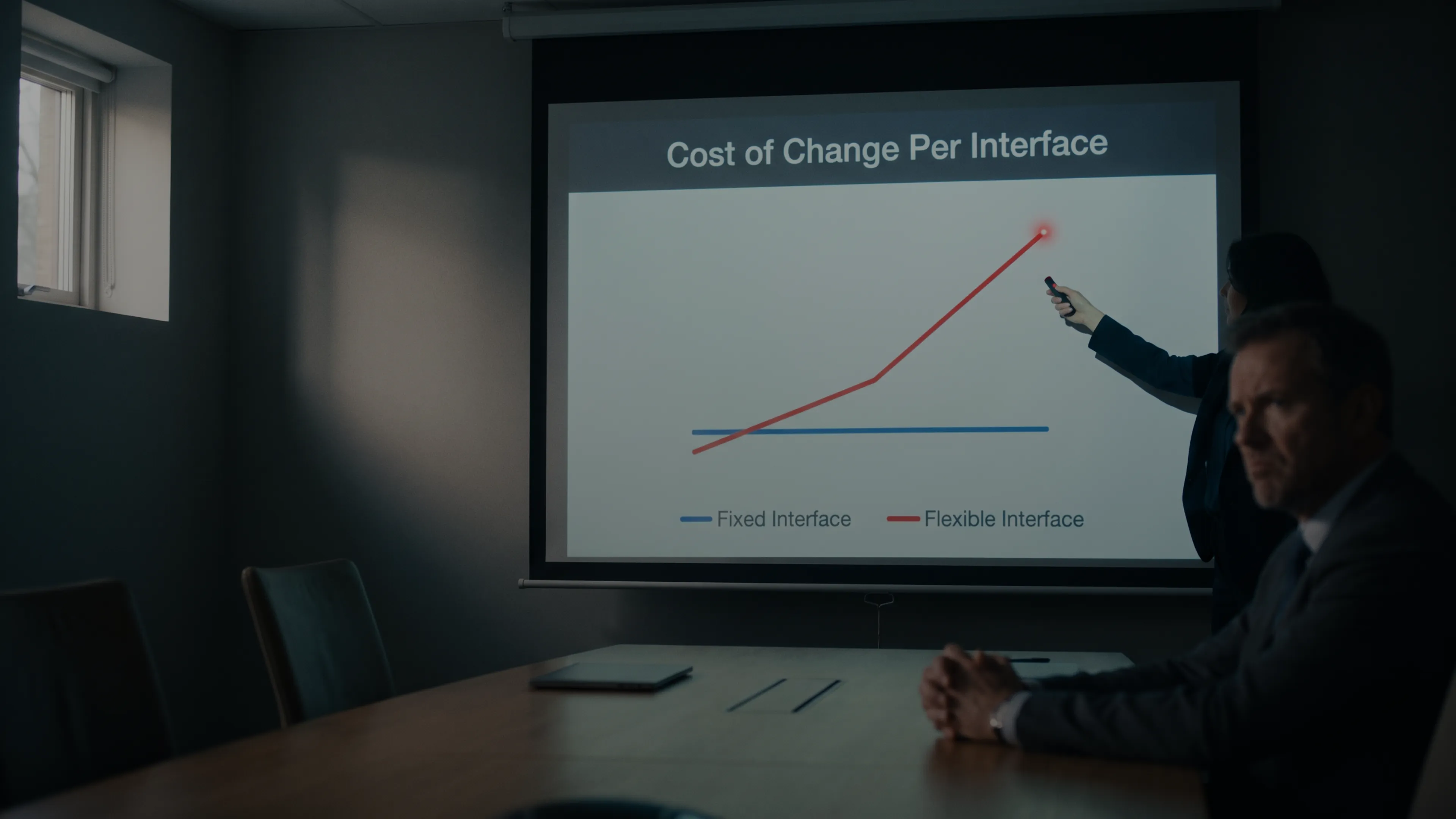
    Every module in your product has a single human owner who treats it as their own, and that ownership standard gives you the authority to say no to unnecessary change. The next article reveals why the most well-intentioned engineering teams undermine that authority every day: by pursuing flexible interfaces that dissolve the very boundaries ownership protects. You'll see how discovery-based interfaces become modularity's silent killer, why 'smart modules' that perform operations stay stable while dumb modules invite constant renegotiation, and what a three-gate governance chain from product management to the CTO looks like. The CEOs who understand this before their engineering teams demand interface flexibility will preserve the modular architecture their competitors quietly lose.

    October 6, 2026 · Article 16

  • Every Piece of the Product Needs a Single Human Owner

    You just finished drawing the boundaries on the whiteboard. Each component now needs a single human who answers for its future, or orphan code will derail your roadmap with surprise projects and burned-out engineers. The next article shows why assigning ownership early locks in the architecture you built, while competitors who skip this step pay later in degraded components and lost velocity.

    September 29, 2026 · Article 15

  • There Are No Natural Boundaries Waiting Inside Your Monolith

    Your monolith has no natural boundaries waiting inside it. Every component is a product with its own margin, and the wrong cut costs more than leaving the whole thing intact. The next article shows how to read the economic signals that reveal where the real seams are, starting with the product, before the sync tax swallows your roadmap.

    September 22, 2026 · Article 14

  • When Your Software Choices Stop Making Economic Sense

    You've built the modular architecture and the clean interfaces, and the system still leaks margin. The next article walks through three economic distortions that turn sound engineering into a money-losing machine: the commoditization trap, the hidden cost of free dependencies, and the CEO override that kills demand-driven work. The first leadership team that recognizes these patterns cuts waste before competitors even see the signal.

    September 15, 2026 · Article 13

  • The Way Teams Talk Shapes the Software They Build

    You walk past a meeting room where two teams are hashing out a small change. That coordination meeting isn't a scheduling problem; it is a structural signal that the architecture has no defined boundary between components. The next article reveals how the CTO can read that signal and redesign the communication structure, using modular interfaces that turn each team into a sovereign unit. The discipline that follows lets you see the margin drain before your next roadmap meeting.

    September 8, 2026 · Article 12

  • The Cost of Not Understanding the Technology You're Building On

    You signed off on a delivery date your team knew was too short. That loan against future capacity compounds invisibly in every sprint after. The next article in The Engineering Tax series goes inside the gap between what a CEO sees and what the software is becoming, and why the CEO's relationship to technology is the most expensive variable in the company's structural cost. The leaders who learn to read the real signals before they commit will operate on a different level of information, and that advantage is theirs the moment they start looking.

    September 1, 2026 · Article 11

  • Your Sprint Report Tells the Truth but Hides Everything That Matters

    The CEO has your Sync Tax multiplier on the slide, nods, and asks when the next feature ships. Data alone gets a nod and a 'next' slide. The next article gives you the trade-off language to turn that metric into a shared decision, so the $40,000 Sync Tax on a feature becomes a visible fork both leaders negotiate together. A CTO who cannot say no costs more than any one bad feature ever could, and this framework gives them the language to say it.

    August 25, 2026 · Article 10

  • The Setup That Turns a 20-Hour Feature Into an 80-Hour One

    Your engineering team just shipped a feature that took 80 hours, but the real work was only 20 and the rest was tax. The next article introduces the Sync Tax Multiplier, a single number that reveals why that happens and shows how to measure the hidden dependencies and coordination overhead that drain your roadmap. This is the metric that makes the invisible visible, and the first CEO who quantifies it outruns competitors who never look.

    August 18, 2026 · Article 9