Where a quarter's extra engineering hours went
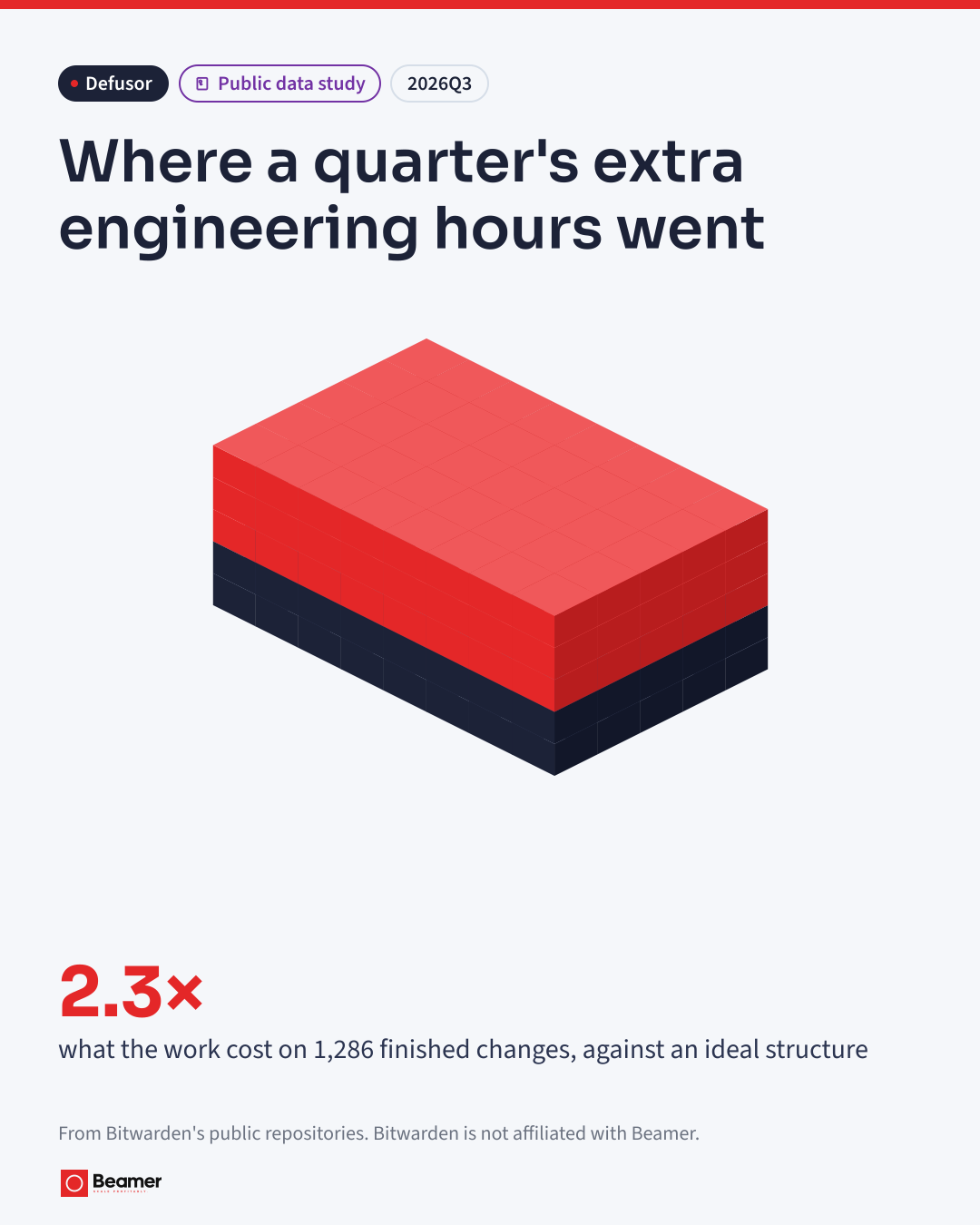
On 1,286 of Bitwarden's 2026Q3 changes, work cost 2.3× what it could have taken with an ideal structure. Most extra hours came from spill-over changes.
Built from Bitwarden's public repositories. Bitwarden is not a Beamer customer and is not affiliated with Beamer.
Key figures
- what the work cost on 1,286 finished changes, against an ideal structure
- 2.3×
- what the work cost on 1,286 finished changes, against an ideal structure
- of sync tax in the quarter, 12,000 hours
- $1.2M
- of sync tax in the quarter, 12,000 hours
- of sync tax was spill-over work
- 86%
- of sync tax was spill-over work
- of sync tax a Shared crypto SDK boundary would remove, the first move
- $120K
- of sync tax a Shared crypto SDK boundary would remove, the first move
At a glance
Public data study- Subject
- Bitwarden, from public data. Not a Beamer customer.
- Period
- 2026Q3
- Product
- Defusor
- Repositories
- 32 public repositories, read as one product
- Finished changes
- 2,119 in the quarter
The question
When a quarter of finished engineering work costs more than it should, where do the extra hours go, and which boundary should be fixed first?
What we measured
Defusor read Bitwarden’s 32 public repositories as one product and counted the 2,119 finished changes in the 2026Q3 quarter. The groups Defusor finds are not Bitwarden’s teams.
Every amount is hours multiplied by a loaded rate of $100 an hour. That rate is our assumption, because we do not know Bitwarden’s real one. The hours are the solid figure. The dollars scale with whatever rate you put in.
Two terms carry the study. Ideal-structure cost is an estimate of what the work could have taken with an ideal structure: each change inside one domain, shipped by one team on its own. Sync tax is the extra cost of today’s structure.
What we found
1. Most of the quarter’s cost was extra
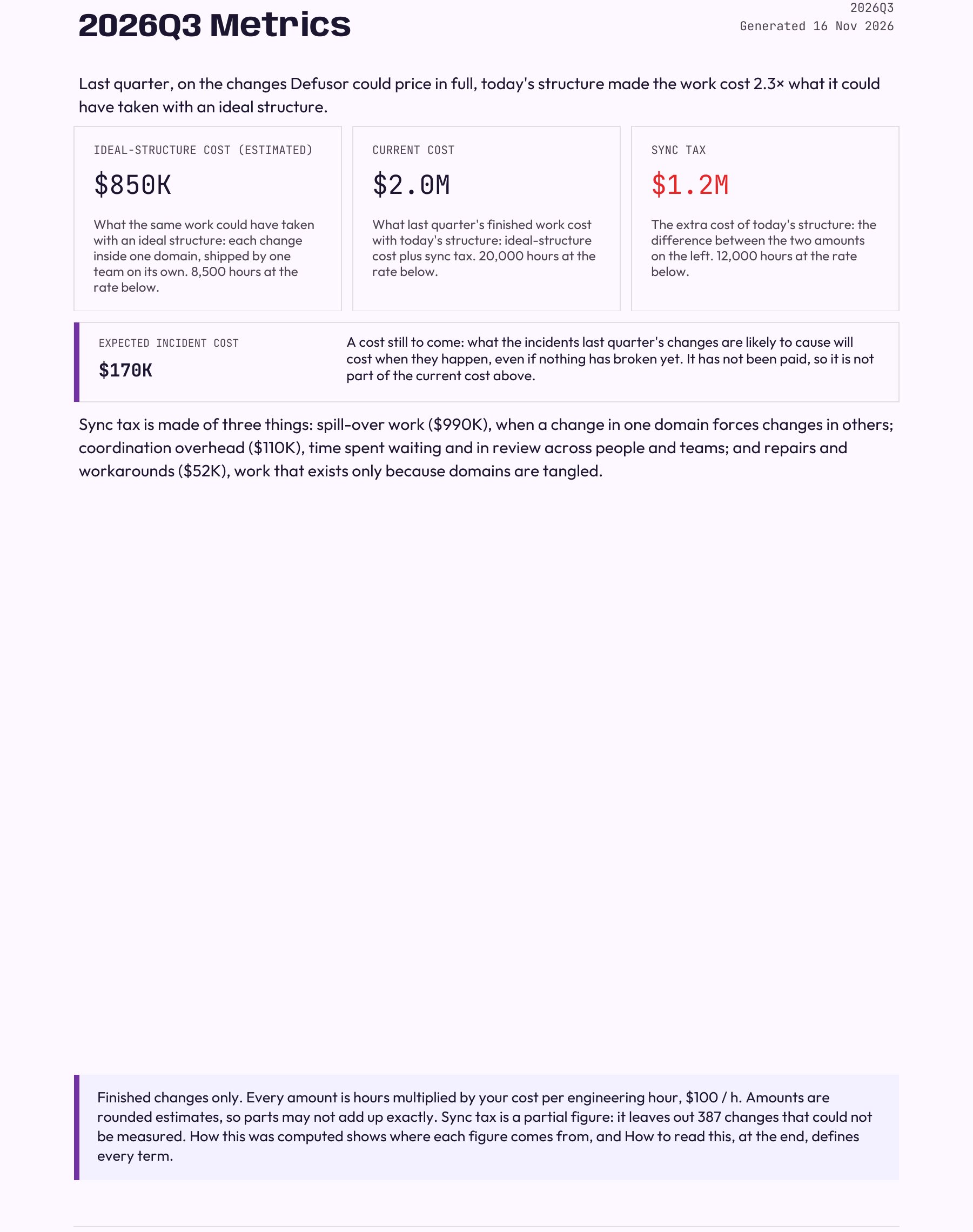
Ideal-structure cost came to 8,500 hours, $850K. Sync tax added 12,000 hours, $1.2M. Together that is a current cost of 20,000 hours, $2.0M. Amounts are rounded estimates, as in the report, so parts may not add up exactly.
The 2.3× is measured on a narrower set: the 1,286 finished changes that have both an ideal-structure cost estimate and priced spill-over work and coordination overhead. On those changes, the work cost 2.3× what it could have taken with an ideal structure. Dividing the quarter totals above gives a different ratio, because they cover more changes.
Ideal-structure cost plus sync tax make the current cost
One stacked bar. Ideal-structure cost: 8,500 h, $850K. Sync tax: 12,000 h, $1.2M. Together, the current cost: 20,000 h, $2.0M.
Amounts are rounded estimates, as in the report, so parts may not add up exactly.
Source: Defusor report, Bitwarden 2026Q3, pages 1 and 8.
Report page 1: metrics
From the Defusor report the figures come from.
Open the full page2. Spill-over work was most of it
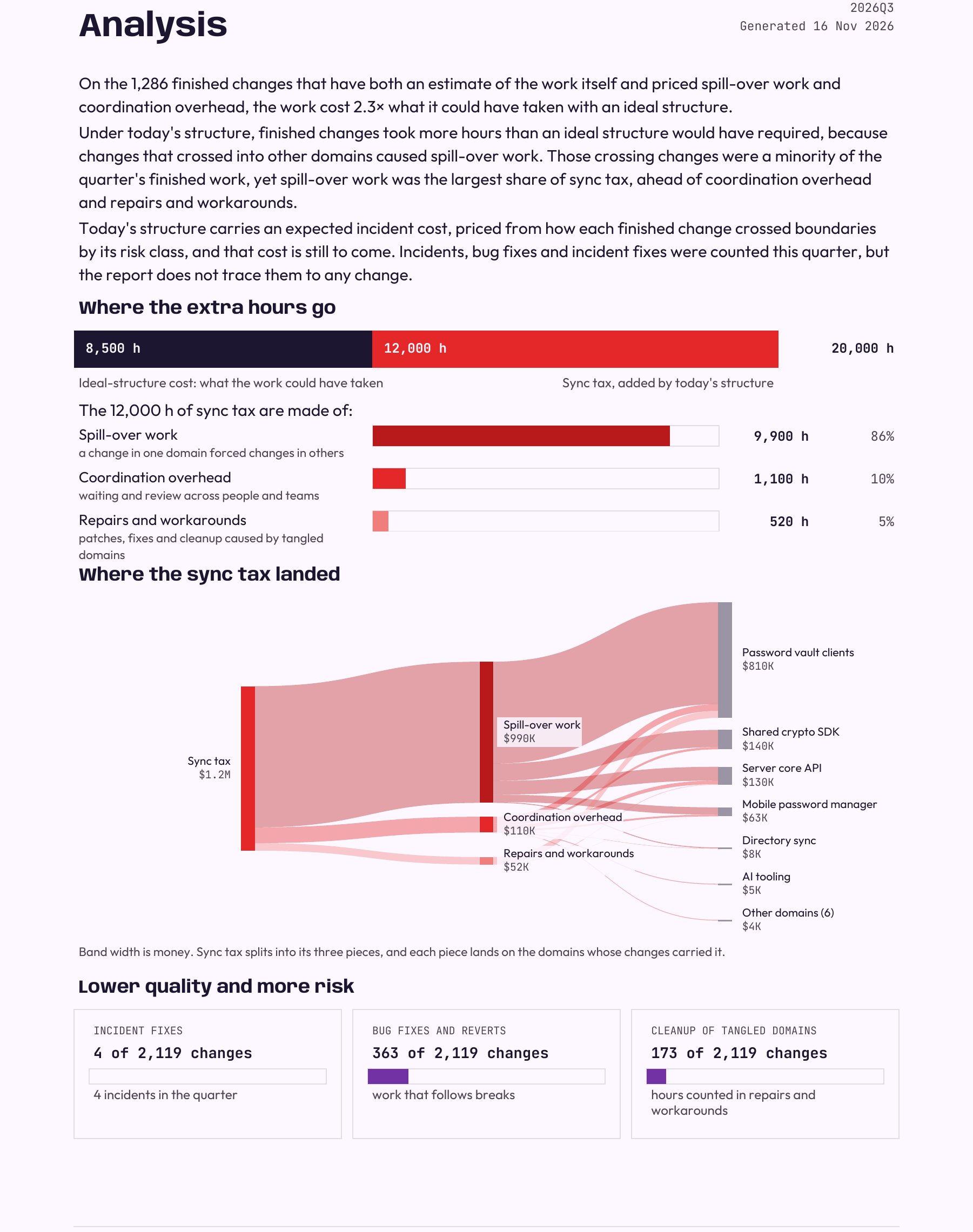
Sync tax has three pieces. Spill-over work is 9,900 hours, 86% ($990K), where a change in one domain forced changes in others. Coordination overhead is 1,100 hours, 10% ($110K), the waiting and review across people and teams. Repairs and workarounds is 520 hours, 5% ($52K), the patches, fixes and cleanup that tangled domains cause.
Most changes stayed inside one domain. The ones that crossed were the minority, and they carried the extra hours.
The three pieces of sync tax (12,000 h)
Spill-over work: 9,900 h, 86%, $990K. Coordination overhead: 1,100 h, 10%, $110K. Repairs and workarounds: 520 h, 5%, $52K.
Each bar is the piece's share of sync tax.
Source: Defusor report, Bitwarden 2026Q3, page 8.
3. It landed in a few places
Password vault clients carried $810K of the $1.2M. Shared crypto SDK carried $140K and Server core API $130K. Mobile password manager carried $63K, Directory sync $8K and AI tooling $5K. Six other domains together carried $4K.
Where the $1.2M of sync tax landed, by domain
Password vault clients: $810K (934 changes). Shared crypto SDK: $140K (222 changes). Server core API: $130K (383 changes). Mobile password manager: $63K (322 changes). Directory sync: $8K (68 changes). AI tooling: $5K (81 changes). 6 other domains: $4K.
Bar length is the domain's sync tax. In brackets, its finished changes in the quarter.
Source: Defusor report, Bitwarden 2026Q3, page 8.
Report page 8: analysis
From the Defusor report the figures come from.
Open the full page4. The plan starts with a smaller move
Each move puts a boundary around one domain, separating it from every domain its changes reach.
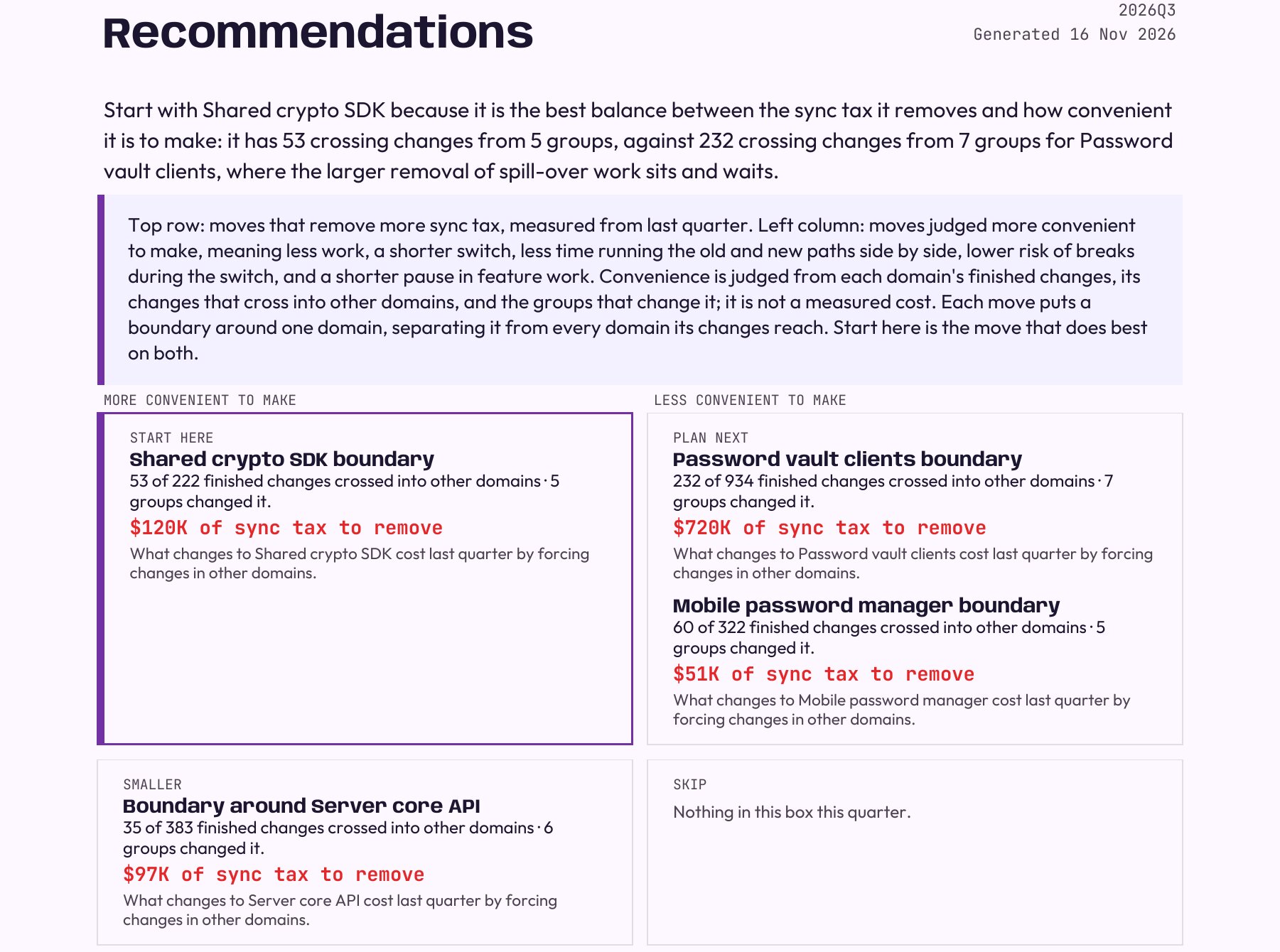
Start with the Shared crypto SDK. 53 of its 222 finished changes crossed into other domains, and 5 groups changed it. A boundary would remove $120K of sync tax. Plan Password vault clients next. 232 of its 934 changes crossed and 7 groups changed it. A boundary there would remove $720K, the larger amount. Mobile password manager (60 of 322 crossed, $51K) is planned next too. A smaller move puts a boundary around Server core API: 35 of its 383 changes crossed, and it would remove $97K.
Which move is more convenient is a judgement based on those counts. It is not a measured cost.
Which boundary first
A two by two grid. Columns: more convenient to make, then less convenient to make. The top row holds the moves that remove more sync tax. Top left, start here: Shared crypto SDK boundary, 53 of 222 finished changes crossed into other domains, 5 groups changed it. $120K of sync tax to remove. Top right, plan next: Password vault clients boundary, 232 of 934 finished changes crossed into other domains, 7 groups changed it. $720K of sync tax to remove. Mobile password manager boundary, 60 of 322 finished changes crossed into other domains, 5 groups changed it. $51K of sync tax to remove. Bottom left, smaller: Server core API boundary, 35 of 383 finished changes crossed into other domains, 6 groups changed it. $97K of sync tax to remove. Bottom right, skip: nothing in this box this quarter.
Convenience is a judgement based on the counts, not a measured cost.
Source: Defusor report, Bitwarden 2026Q3, page 10.
Report page 10: recommendations
From the Defusor report the figures come from.
Open the full pageWhat it means for a CEO
The extra cost was concentrated. It sat in changes that reached across domains, and one domain, Password vault clients, carried $810K of it. So the first question is about boundaries: which domain does the most damage when it changes, and how many other domains does it reach?
The report puts the Shared crypto SDK first and Password vault clients next, and it counts how many of each domain’s changes crossed into other domains and how many groups changed it. Those counts come from git history, which a leadership team can check against its own product.
Limits
The rate is assumed. $100 an hour is our figure, not Bitwarden’s.
387 changes could not be measured, and their sync tax is not in these figures.
Ideal-structure cost is an estimate. It rests on 1,307 of the 2,119 changes.
Expected incident cost is a floor, and it is a cost still to come, not one already paid: $170K. Where real incidents exist, the estimate per incident was 4 hours against a measured 9 hours. The quarter had 4 incidents, which took 37 hours to fix.
This is one run. Figures can move between runs on the same data: in one test, repairs and workarounds moved by 7%.
Domain names and groupings come from one model reading of the code and can differ on another run.
We used public data only and had no access to Bitwarden’s internal tools.
See it on your own code
Defusor reads your git history and returns this report for your product.
Keep going
Products
- DefusorEngineering overspend measured from your git history, in a quarterly PDF report.
- Engineering Cost ReportA free PDF on where the engineering budget goes, from 18 multiple-choice questions.
- Engineering Cost CalculatorThe Sync Tax and the Total Cost of Complexity from your own estimates, and what AI adoption does to them.
Reading
- What module coupling actually costs youSeven modules moving together, with coordination hours at zero, returns 4.50x, $27,000 per feature, and $1,008,000 a year.
- What coordination overhead costs a software companyTwenty coordination hours on a 40-hour feature add $3,000 on the coordination line. The annual figure for these inputs is $489,600.