The Engineering Tax · Article 8 of 29
Recruitment Is a Strategy Decision, Not an HR Task
You tracked the cost of your own technical decisions, but the harder question is whether the people around you are the right ones for what comes next. The next article reveals that recruitment is your company's immune system, the interview decides the next two years, and creative destruction applies to human capital as surely as it applies to strategy. A team built on entitlement instead of execution is the fastest path from margin to crisis, and the leaders who treat hiring as strategy will have teams that survive pivots their competitors can't.

Recruitment and the Innovation Mindset
Recruitment is a strategy decision, not an HR task. The people you hire and how you treat them is the company’s immune system against cultural and operational decay. This article is about treating human capital with the same discipline you apply to product strategy, and about removing the cultural elements that corrode it from the inside.
The interview is where the next two years of the company get decided. Run it well and the company hires its own future. Run it badly and the company hires its own disease.
Disclaimer
Before the substance, a direct note. If you lean toward the progressive or left worldview, this article will not sit well with you. I am intentionally hard on that mindset because it has radicalized into something destructive. What started as a political preference has become an ideology built on resentment and entitlement that corrodes company cultures from the inside. A team that adopts that mindset will watch its best performers leave and its worst patterns harden. If that sounds like an unfair characterization, this article is not written for you.
1. Creative destruction in practice
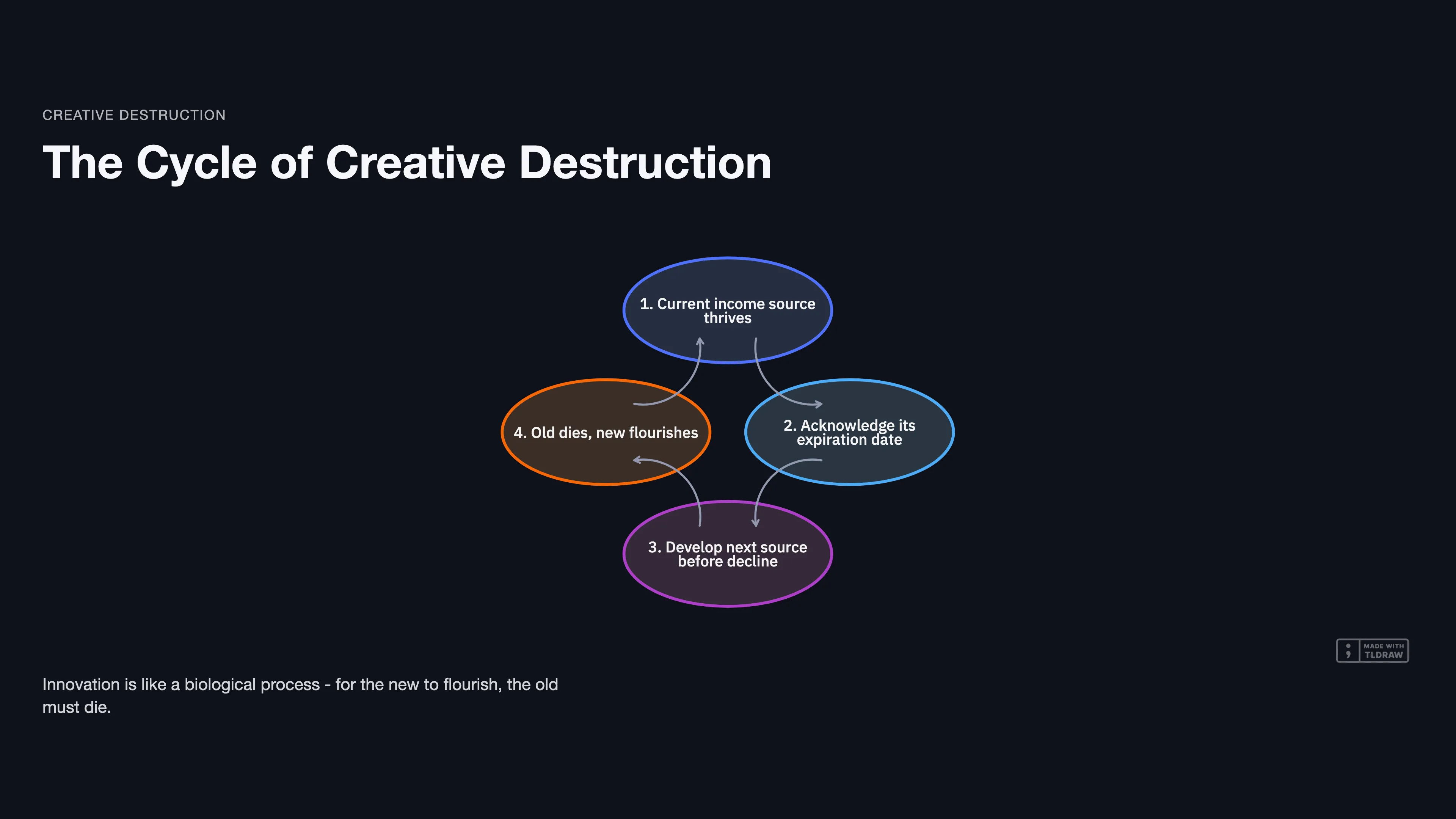
Innovation is like a biological process. For the new to flourish, the old must die. This cycle is what economists call creative destruction, and it is essential for a company’s survival, and it must be reflected in its human capital strategy. A CEO who doesn’t know what creative destruction is should probably not be a CEO.
- Skate to where the puck is going. Christensen brought Gretzky’s quote, “I always skate to where the puck is going to be”. A leader must skate to where the money will be. This means acknowledging that current core competencies and roles that never change have an expiration date.
- Nothing must die until it’s time to die. Of course nobody should kill the main source of income. That would be suicidal and stupid. Germany killing its nuclear plants without an affordable source to produce energy is the kind of decision that only progressive politicians make. The CEO’s challenge is to watch the current main source of income, accept that it will become obsolete at some point, and start developing the next one before the current one dies. That is what Christensen means by skating to where the puck is going to be.
- Avoid the anti-stagnation trap. Massive layoffs trace back to leadership negligence. Constant, incremental reallocation of resources prevents the need for catastrophic, large-scale cuts. A company that protects roles losing their business value concentrates all the pain into a single day when the reckoning finally arrives.
- Human capital depreciates like any other asset. Changing jobs, learning new skills, and acquiring new experience is what keeps a professional’s market value from depreciating. The depreciation of human capital is a general principle, not a software-engineering one. Do not put modularization at the same level as the decision to stop learning. A company that protects static roles is actively harming the long-term career of the employee, and it is lying to itself about being kind.
2. Recruitment: filtering for the entrepreneurial mindset
Recruitment is the primary defense against systemic inefficiency and cultural decay, and the interview is the first filter that decides what kind of company this will be in two years.
- Filter for the high-performer profile. Look for candidates with entrepreneurial experience, or people who have successfully handled major pivots. People who have built something from scratch, or steered a team through a major shift, understand that roles evolve, that comfort has an expiration date, and that stability lives in their ability to execute rather than in any job description.
- Ask interview questions that actually test for it. Stop asking trivia and instead ask candidates directly how they reacted the last time their role changed, what they thought when the company pivoted, and what extra perks they would expect. Then listen carefully to how they answer. A candidate who treats the question as offensive is telling you everything you need to know. A candidate who answers with stories of adaptation is telling you the opposite and it’s a sign that the candidate might be a valuable addition.
- Keep the HR function healthy and ideologically neutral. The CEO is responsible for making sure the HR department is healthy. HR that is infected with the entitlement-and-resentment mindset will let the same people walk in through the front door. Party affiliation stays out of the interview. The behavior the mindset produces does not, and the resentful, hateful, and criminal mindset the left provokes is exactly the kind of behavior that earns the right to be screened out. You are judging a pattern that destroys teams and lives, and that pattern has a clear ideological fingerprint you would be blind to ignore. If a candidate carries the entitlement-and-resentment mindset into the interview and the company wants a toxicity-free culture, leave them at the door. One bad hire carrying that mindset can seed dysfunction for months.
3. Adult-to-adult partnership
The modern trend of wrapping jobs in comfort, perks, and “employment joy” has created fragile environments. Adults do not need their job to be constantly pleasant. They need a deal that respects their intelligence and makes them more valuable over time.
- The deal is mutual. A job is a high-alignment partnership. The company benefits from expertise and highly effective organization. The employee benefits from compensation and, crucially, experience that updates and increases his market value. That is the entire contract. Anything beyond it, framed as a “right” paid by the employer, is a fiction that has to be paid for by someone, and it usually ends up being paid for by the people who actually produce.
- The “rights” myth. The concept of employer-paid rights, beyond the agreed compensation and the professional growth the deal already includes, is rejected. A job is a partnership. The moment “rights” become the dominant language, the company is one step away from being run by grievance committees. And let’s not start talking about labor unions.
- Boring work is part of the deal. Cleaning up legacy code and removing accumulated complexity is a project, not a permanent job. Adults must accept that work is not always pleasant, and the right move is to do the project without drama. The last couple of decades, especially the software engineering industry, wrapped the job in comfort, perks, and “employment joy.” That madness did not come out of thin air. It came from a time when engineering talent was scarce, expensive, and hard to replace, so companies competed for it with perks, and engineers learned to abuse the industry and started to feel entitlement for those perks. Those market conditions are gone now. Engineers today can’t find a better job as quickly as years ago, and companies can be more clear about the terms of the deal going in.
- Dealing with toxicity. Entitlement and resentment act as a cancer. Managers must identify toxic behavior, like envy-driven complaints and a focus on “rights” over “results,” and remove it as soon as possible. One warning, then an exit. Give zero millimeter to the people who carry this mindset, because they will use it to destroy the team from the inside. Every manager owns the team’s behavior, not just the CEO. The standard is one bad behavior and a warning, two and they are out. Keep political views out of recruitment and judgment. The behavior the mindset produces is fair game, and the modern left is not shy about producing it. If the manager doesn’t do his job removing toxicity, then his best performing people will leave first.
4. Exit protocol: transparency over shock
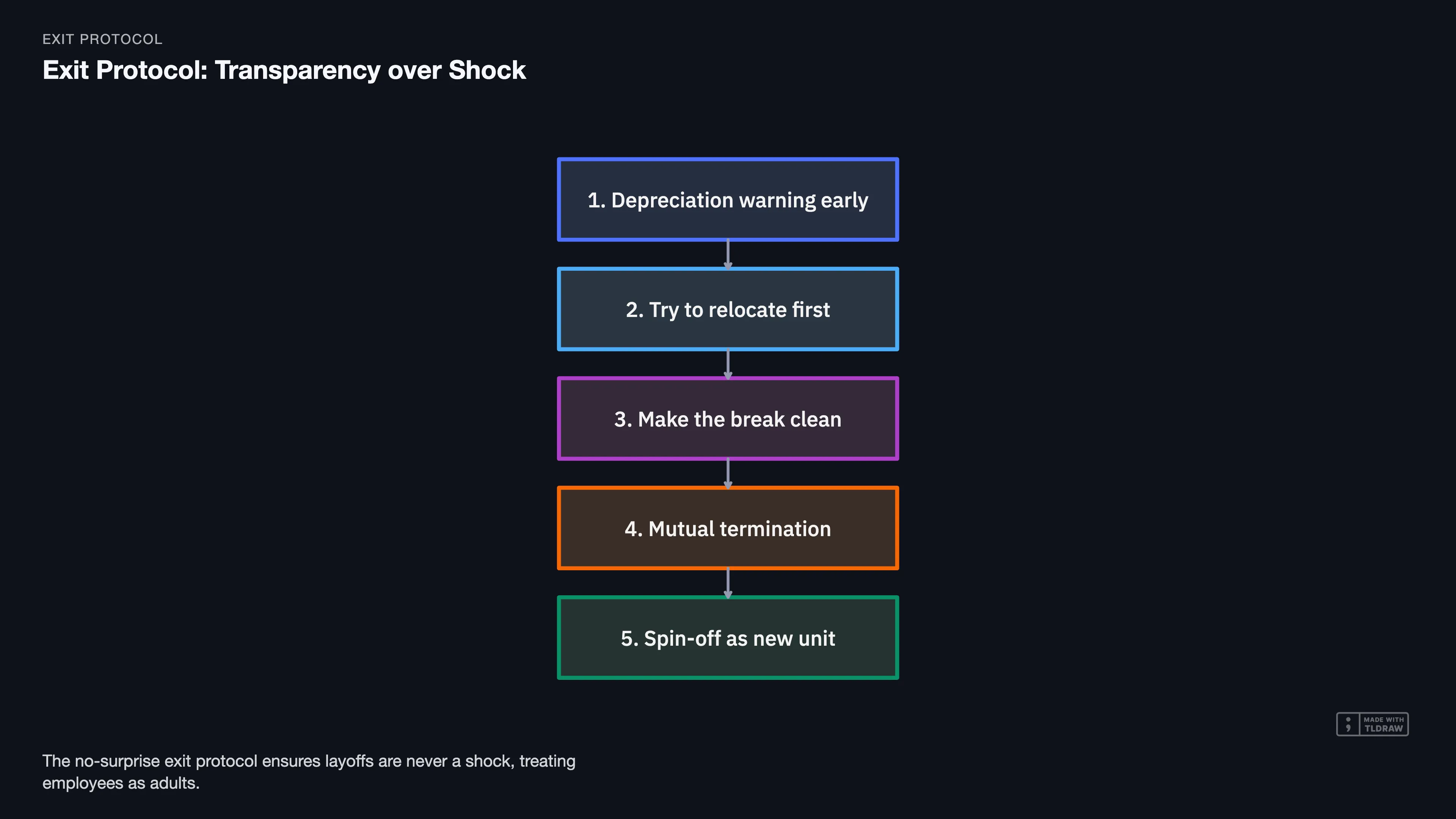
If a company is transparent from day one, a layoff or a role elimination is never a surprise. The employees already know the trajectory because the company has been telling them.
- Give the depreciation warning early. Employees should be informed early when their current position or department is losing its business value. The information is the basic respect due to an adult who can use it to make better decisions, and framing it as cruelty is a mistake. If a CEO announces in some all-hands that he will never conduct a layoff, he’s lying. Start preparing your exit with enough time.
- Try to relocate first. When a role or department is losing its business value, the first move is to see if the employee can be relocated into a different business unit or position. A company is, at the end of the day, a group of people working together toward a shared goal. If the fit between the person and the role is gone, the cheaper and more respectful move is to find them a different seat inside the same company before looking outside. In practice, transferring good employees to different positions should be a more common practice, because it preserves institutional knowledge and saves the company the cost of recruiting and training a replacement. The employee stays because the new role is a better fit, not out of any fanatical sense of loyalty. Staying in a bad role out of guilt, fear, or cult-like attachment is not a virtue but a slow harm to the employee’s market value, and the company should not encourage it.
- Make the break clean. If retraining fails after multiple attempts, the most respectful and financially sound act is a clean break. The company should budget for it, the same way it budgets for any other predictable cost. Some exits are caused by toxicity, and those should be fast. Others are not bad hires at all. People keep evolving, and sometimes they just become incompatible with the role as it now exists. Either way, the budget for parting ways cleanly is part of running the company in good order.
- Mutual termination is a sign of respect, not failure. When the no-surprise protocol has worked, the exit conversation is between two adults who already share the same facts. A mutually agreed contract termination is a sign that the company appreciated the employee but has to keep moving. There is nothing personal in it, and that is exactly what makes it dignified.
- Spin-offs. Transitioning a team or department into an independent business unit is a valid strategy for managing stable-but-depreciating sources of income. This works at the team or business-unit level, where a coherent group of people can be set up to run on its own. People are not swappable modules, and that principle still holds. But a team is a business entity, and treating it like one is fair. From the company’s point of view, individual employees are still resources that can be hired and fired at convenience. The job of the CEO is to keep the company alive, not to keep every individual seat safe.
5. Stability anchor
In a world of constant change, stability is found internally, not in a safe seat. The seat will move, but the skills travel with the person.
- Performance is the motivation. High performers find their stability in their own ability to execute and in the market value they keep building. The person who needs a fixed job title to feel safe will burn out the moment a reorg affects him. The person who trusts his own execution will treat the reorg as part of the job.
- Keep the cultural anchors fixed. While roles and strategies change, the company’s core mission and its standard of excellence remain fixed. Those are the only anchors that hold under pressure. Roles change, strategies pivot, but the mission and the bar do not bend for convenience or politics.
- Move from job security to freedom. Cultural change is required here. The high performer finds motivation in the experience and the high performance itself. The cultural aspect should help the employee gradually shift from a “security first” mindset to a healthier one based on freedom, not totalitarianism. That is the real antidote to burnout, and it is the only one that scales.

Closing
The pattern across every section is the same. The company is a living system, and the people inside it are the immune system. When recruitment misses, the company hires its own disease. A culture built on grievance instead of results destroys any team from the inside. Executed poorly, the exit protocol concentrates all the pain into a single day. And confusing a fixed seat with stability creates stagnation, not safety. The CEO’s responsibility is to keep the company alive sustainably, and to do it with adults, on adult terms. Anything else is pink cotton wrapped around a slow death.
References
- Schumpeter, J. A. (1942). Capitalism, Socialism and Democracy. Harper & Brothers. The concept of creative destruction as the essential fact about capitalism, describing the process of industrial mutation that incessantly revolutionizes the economic structure from within, destroying the old one and creating a new one. Wikipedia
- Christensen, C. M. (1997). The Innovator’s Dilemma: When New Technologies Cause Great Firms to Fail. Harvard Business School Press. Christensen’s foundational work on disruptive innovation, which reframes the Gretzky quote “skate to where the puck is going to be” as a strategy for anticipating market and technology trajectories rather than optimizing current positions. Wikipedia
- Christensen, C. M. & Raynor, M. E. (2003). The Innovator’s Solution: Creating and Sustaining Successful Growth. Harvard Business School Press. Christensen further develops the “skate to where the puck is going” metaphor in the context of strategy development, urging companies to track shifting customer “jobs to be done” and emerging trajectories. HBS Faculty
- Christensen, C. M. (2001). “Skate to Where the Money Will Be.” strategy+business, Issue 23. An interview where Christensen explicitly invokes the Gretzky idea to explain why companies like IBM divested from microprocessors and operating systems, staying where the money used to be instead of skating to where it was going. strategy+business
← Previous: Decisions That Look Good Today and Hurt the Company Tomorrow
Up next in The Engineering Tax · Article 9
The Setup That Turns a 20-Hour Feature Into an 80-Hour One
Your engineering team just shipped a feature that took 80 hours, but the real work was only 20 and the rest was tax. The next article introduces the Sync Tax Multiplier, a single number that reveals why that happens and shows how to measure the hidden dependencies and coordination overhead that drain your roadmap. This is the metric that makes the invisible visible, and the first CEO who quantifies it outruns competitors who never look.
Frequently asked questions
Creative Destruction Applied to Human Capital
What does creative destruction mean for hiring and roles?
Creative destruction is the cycle where the new replaces the old so the company can survive. Applied to human capital, it means acknowledging that roles, competencies, and department structures have expiration dates. A CEO who only protects today's seats is skating to where the puck used to be. The job is to develop the next source of value before the current one dies, while reallocating people incrementally instead of waiting for a crisis layoff.
Why is protecting static roles harmful to employees?
Human capital depreciates like any other asset. Changing jobs, learning new skills, and acquiring new experience keeps a professional's market value from rotting. A company that shields people in roles losing business value is lying to itself about kindness. It concentrates pain into a single reckoning day and harms the long-term career of the employee who stays frozen in place.
Exit Protocol: Transparency Over Shock Layoffs
What is a transparent exit protocol?
If a company is honest from day one, a layoff or role elimination is never a surprise. Employees already know the trajectory because leadership has been saying it. Give the depreciation warning early when a position or department is losing business value. Try to relocate the person into a better-fit seat inside the company first. If that fails after real attempts, budget for a clean break the same way you budget any other predictable cost.
Why is mutual termination a sign of respect?
When the no-surprise protocol has worked, the exit conversation is between two adults who already share the same facts. A mutually agreed contract termination signals that the company valued the person and still has to keep moving. There is nothing personal in it, and that is what makes it dignified. Toxicity exits should be fast. Role-fit exits should be prepared, funded, and adult.
Why Recruitment Is a Strategy Decision, Not an HR Task
Why is recruitment a strategy decision rather than an HR task?
The people you hire and how you treat them are the company's immune system against cultural and operational decay. The interview is where the next two years of the company get decided. Run it well and the company hires its own future. Run it badly and the company hires its own disease. That is capital allocation of human capacity, not a back-office process.
What should interviews filter for?
Filter for high performers with entrepreneurial experience or people who have steered through major pivots. Ask how they reacted the last time their role changed, what they thought when the company pivoted, and what extra perks they would expect. Candidates who treat adaptation as offensive are telling you everything you need to know. Keep HR ideologically neutral, judge behavior that destroys teams, and leave entitlement-and-resentment patterns at the door.
Newsletter
Be the first to get next articles in this series.